SQLShift Technical Practice: Making AI Truly Usable, Trustworthy, and Deployable in Database Migration
 Dec 22, 2025
In database migration, AI is attracting high expectations. But one practical issue is becoming increasingly clear: if you rely only on a model, migration risk is not reduced and may even be amplified. SQLShift was born and continues to evolve under this reality.
1. Key Challenges in Database Migration
When enterprises upgrade IT architecture, move to the cloud, or replace legacy databases, migration is a core and unavoidable task. In practice, migration difficulties are concentrated in two layers:
1) Table object layer
Field type mapping, length adjustments, and default-value corrections are already handled well by many tools (such as OMA, OMS, and DTS).
2) Non-table object layer
Non-table objects such as stored procedures, functions, triggers, packages, and views contain real business logic, and they are the most error-prone part of migration. Even in “apparently compatible” migration paths, many problems still appear. For example:
- In Oracle -> OB_Oracle migration:
SYSDATE()works in Oracle but fails in OceanBase.- The
USINGclause of dynamic SQL behaves more strictly on the target side.
- Full-width symbols, implicit type conversion, and permissive syntax often fail directly in the target database.
- Some domestic databases claim “full compatibility,” but key behavioral differences are not documented. These hidden dialect differences force DBAs to read line by line, debug repeatedly, and rewrite manually, with high cost and risk.
2. Why Is “Direct LLM Migration” Not Reliable?
In SQLShift’s early research and practice, we did not blindly assume AI alone would solve migration. Instead, we systematically validated one question:
Do LLMs truly have reliable database syntax and version-awareness capabilities?
🔍 Evaluation findings (from multi-model testing)
After comparative evaluations of mainstream LLMs (including GPT, Claude, Gemini, DeepSeek, Qwen, and Kimi), we reached a consistent conclusion:
Even top-ranked models still commonly hallucinate on database versions and implementation details.
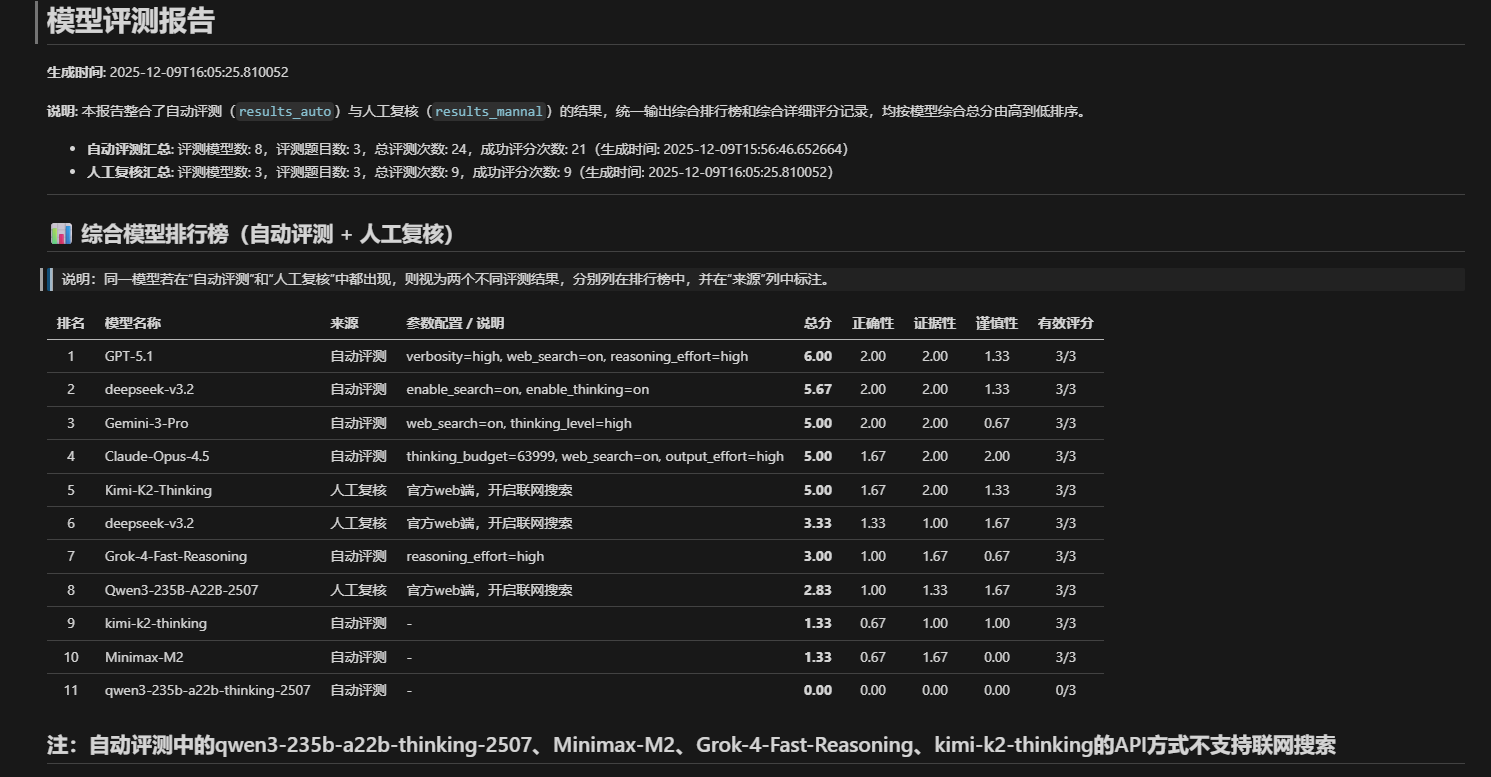
Key findings include:
- Relying only on model “internal knowledge” for compatibility questions is not reliable enough.
- Web-enabled search improves outcomes, but still cannot guarantee consistently correct answers.
📌 Typical test questions
- From which version does OceanBase MySQL mode support temporary tables?
- Does GaussDB v2.0_3.x (centralized edition) support
ON COMMIT DROP? - Does GaussDB v2.0_3.x (centralized edition) provide a built-in UUID generation function? To DBAs, these are verifiable facts, yet LLMs frequently produce:
- Incorrect version numbers
- Features that do not actually exist
- Behavior descriptions inconsistent with official documentation This means:
If migration SQL is generated freely by an LLM without constraints, risk is uncontrollable.
3. SQLShift Core Approach
Based on these findings, SQLShift defined its technical direction from day one:
AI is a capability amplifier, not the sole source of truth.
SQLShift positioning
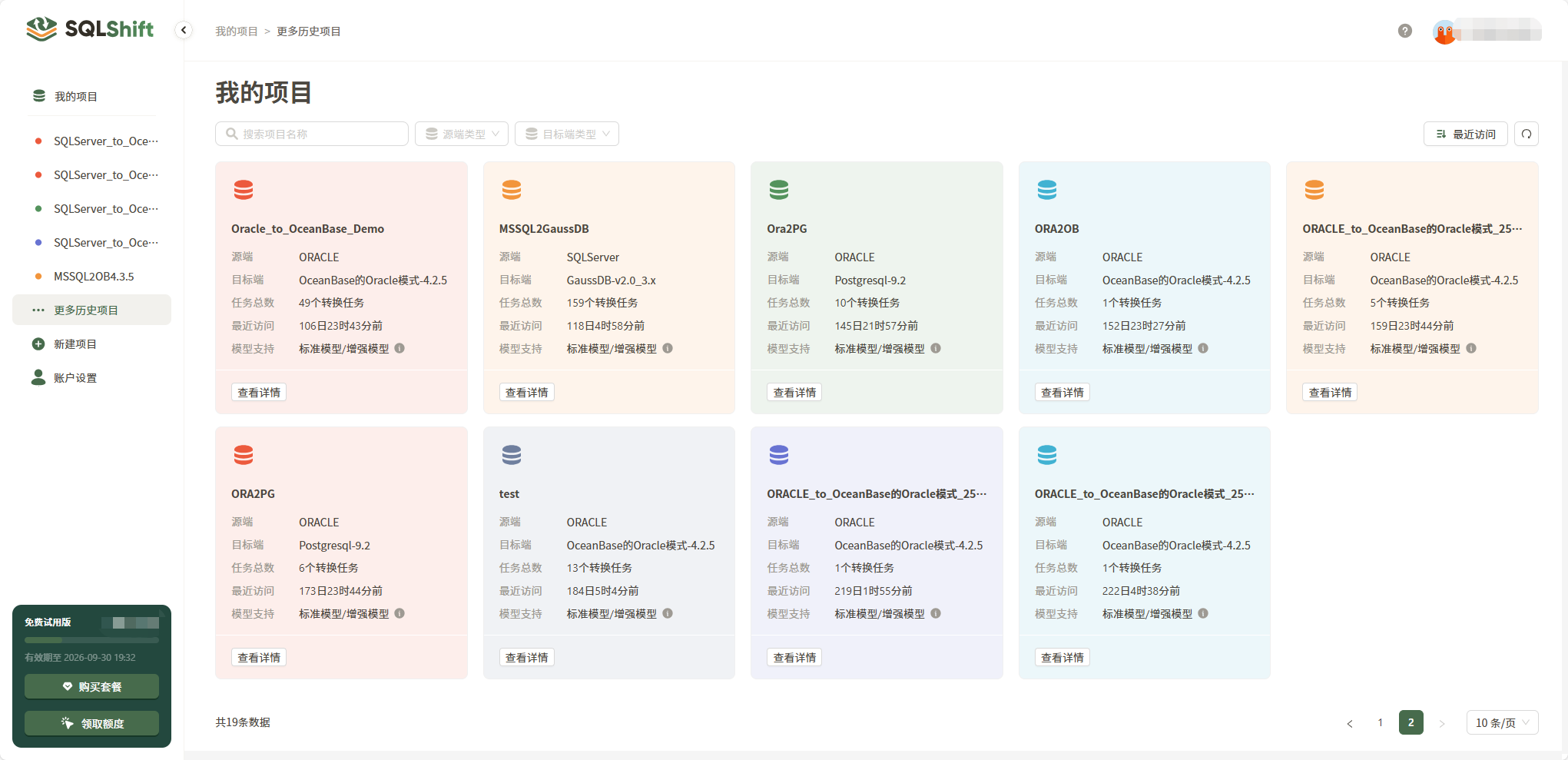
SQLShift is an intelligent dialect-conversion tool focused on non-table database objects. Its “intelligence” is not a single-model capability, but an engineered AI migration system.
4. How SQLShift Makes AI Controllable in Migration Scenarios
1) Domain-specific fine-tuning, not generic Q&A
SQLShift does not depend on model “general memory.” Instead, it:
- Uses official database documentation, syntax specifications, and best practices
- Incorporates stored procedure and function cases from real migration projects
- Builds high-quality training and validation datasets through DBA manual review There is only one goal:
Teach the model the real database world, not internet impressions.
2) Multi-layer validation, not one-shot generation
In SQLShift, AI generation is a starting point, not the end:
- Syntax validation: verify executability through the target database parser
- Semantic validation (in progress): use a second model to review high-risk logic
- Historical case comparison: match against known compatible and incompatible patterns This avoids hidden risks where SQL “looks right but is actually wrong.”
3) Human-AI collaboration, not black-box AI
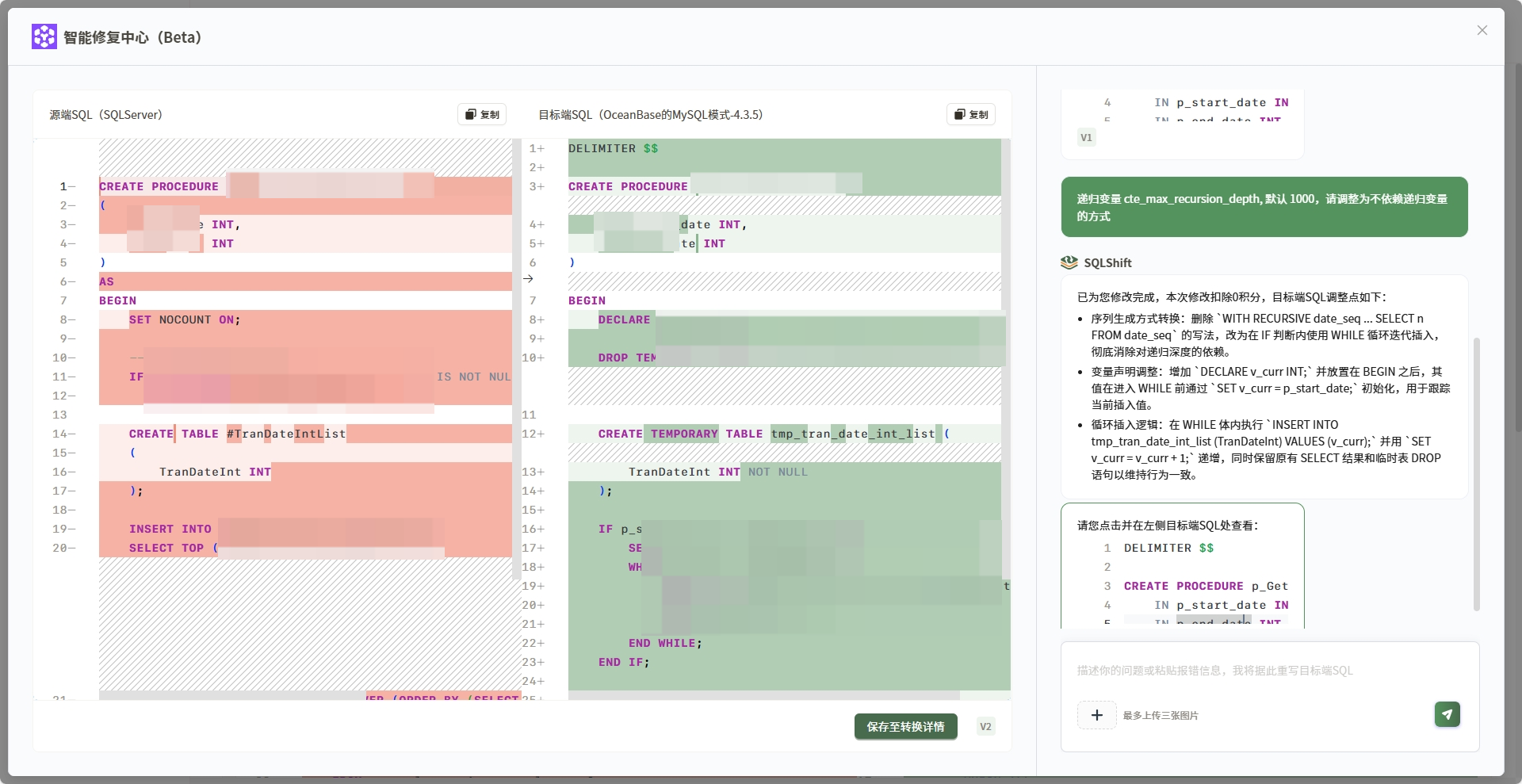
For highly complex code or low-confidence model outputs:
- SQLShift explicitly marks risk points
- Provides conversion rationale and revision suggestions
- Allows DBAs to confirm quickly and trigger automatic adjustments
Every user feedback loop is fed back into model and rule optimization.
4) Modular decomposition for very large objects
For stored procedures with thousands of lines:
- SQLShift first decomposes logic into modules
- Converts each submodule separately
- Reassembles them on the target side This addresses context-length limitations and significantly improves accuracy.
5. SQLShift’s Value: Not Replacing DBAs, but Reducing Migration Uncertainty
In database migration, uncertainty itself is often the largest cost. SQLShift’s core value is:
- Making hidden dialect differences visible
- Turning migration from “experience-based guessing” into an evidence-based, validated engineering process
- Greatly reducing repetitive manual work and trial-and-error costs for DBAs in non-table object migration Whether junior DBAs or experienced experts, users can leverage SQLShift to:
Spend time on judgment and decision-making, instead of endless trial and error.
Closing Remarks
AI is reshaping database migration, but truly usable AI must be constrained and validated by engineering systems. SQLShift has chosen a slower but more reliable path: not to appear “smart,” but to deliver SQL that runs, works, and ships on real databases. That is the true value of AI in database migration.
🎁 Limited-Time Offer
To lower the barrier for experiencing intelligent migration, SQLShift is currently free to use during the campaign period. All users can try AI-driven syntax conversion for non-table objects online.
📅 Campaign deadline: December 30, 2025
If you are facing database migration challenges, especially with non-table objects such as stored procedures, you are welcome to join the free trial and evaluate AI’s value in real migration scenarios with SQLShift.