
Practical Case Study: Migrating SQL Server Stored Procedures to OceanBase
 Oct 22, 2025
As OceanBase adoption accelerates across key sectors such as finance, government systems, and large internet platforms, more SQL Server-based enterprises face the same challenge:
How can SQL Server workloads be migrated to OceanBase smoothly?

A senior DBA responsible for migration projects noted that the biggest challenge is not table structures or data volume, but compatibility and logical consistency in stored procedures.

SQL Server includes many vendor-specific constructs (such as variable scoping, output parameters, and system functions) that cannot run directly on OceanBase. Manual rewrites therefore consume significant time and engineering effort.

Against this backdrop, SQLShift was introduced as an intelligent migration tool. It automatically identifies SQL Server stored procedure structures and converts them into OceanBase (MySQL mode) syntax, helping teams adopt domestic database platforms faster.
1. SQLShift in Practice
The following real-world stored procedure originally ran in a SQL Server environment, with OceanBase 4.2.5 (MySQL mode) as the migration target.

2) Automatic Conversion with SQLShift
After uploading the source stored procedure to SQLShift, an OceanBase-compatible version is generated within minutes. SQLShift automatically detects, rewrites, and validates critical syntax to preserve logic consistency.
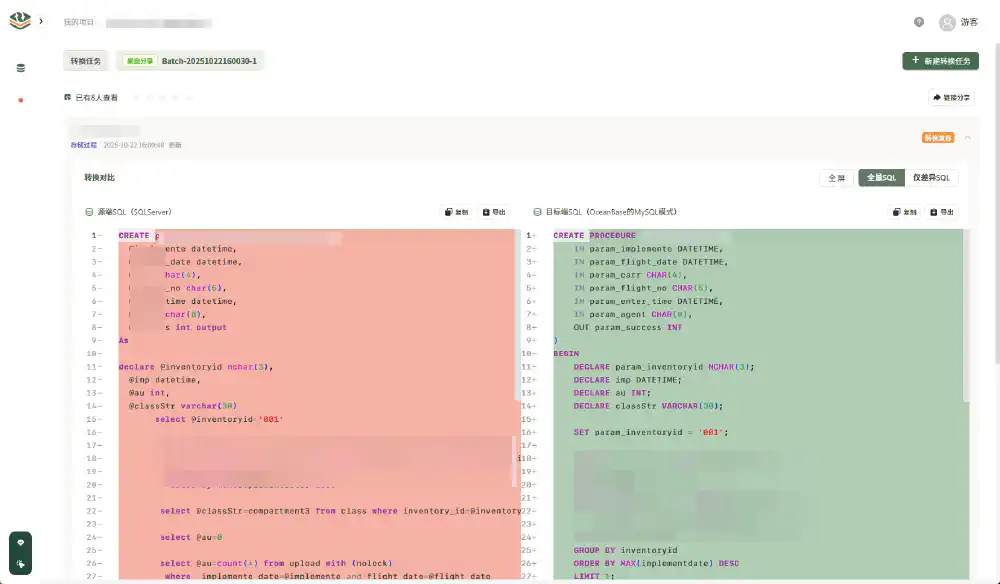
3) Syntax Conversion Analysis
During migration, the following SQL Server constructs are incompatible with OceanBase MySQL. SQLShift identifies and converts them automatically:

| Type | SQL Server Syntax | OceanBase MySQL Alternative | Notes |
|---|---|---|---|
| Parameter declaration | @param type output | OUT param_name type | Explicit direction declaration |
| Variable declaration | declare @x int | DECLARE x INT; | One declaration per line |
| String function | rtrim(ltrim(x)) | TRIM(x) | Preserves semantics |
| Substring search | charindex(a,b) | INSTR(a,b) | Equivalent semantics |
| Top-one query | TOP 1 ... ORDER BY ... | ORDER BY ... LIMIT 1 | Semantic conversion |
| Output variable assignment | SELECT @x = ... | SELECT ... INTO x | OceanBase MySQL syntax |
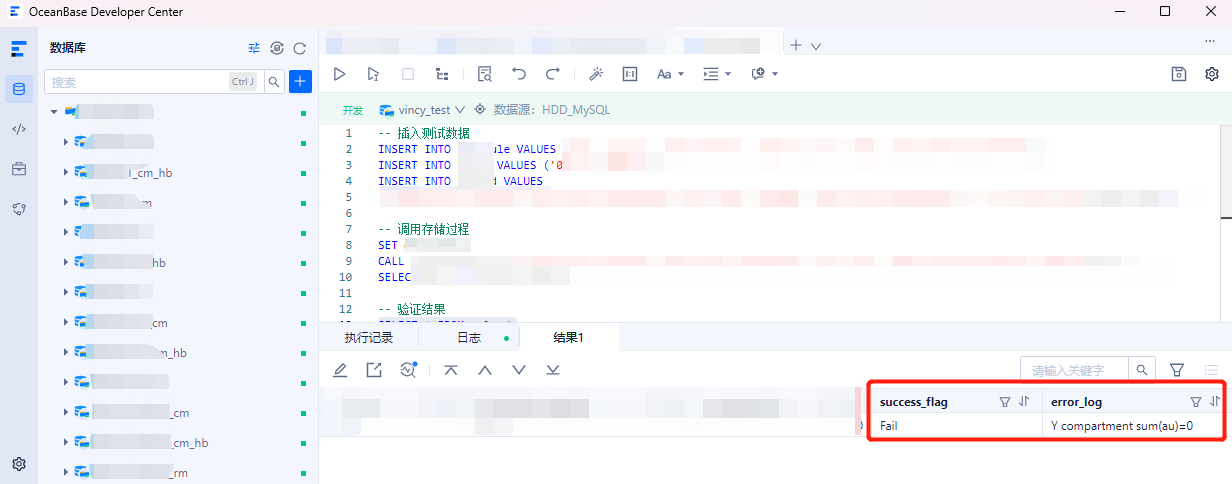
4) Migration Result Verification
The converted stored procedure can be created successfully in OceanBase MySQL 4.2.5.


When executed with the same test dataset, SQL Server and OceanBase produce fully consistent results.

2. From Manual Rewrites to Intelligent Migration
Traditional stored procedure migration often requires:
- Deep knowledge of syntax differences between two databases
- Manual rewriting of procedure logic
- Multiple rounds of consistency validation
 Now SQLShift compresses this workflow into three steps: Upload -> Convert -> Validate, improving DBA migration efficiency by several times.
For teams, this means:
- Less manual intervention: automatic compatibility detection
- Higher accuracy: rule-based and semantic-driven conversion
- Shorter validation cycles: faster generation of executable outputs
3. Conclusion
This practical migration validates SQLShift’s capabilities. In SQL Server-to-OceanBase stored procedure migration, SQLShift can automatically handle most syntax conversion tasks. For medium-complexity procedures, it can even achieve near-zero manual rewriting, significantly reducing migration timelines, costs, and risks.
Try It Now 📢
- Want to quickly evaluate migration results? Free online trial is available.
- Have other migration needs? Submit the survey, and we will collect requests for scheduled support.